Skip to content
  • Home
  • About
  • Trip Reports
  • Gym Training
  • Instagram
  • Youtube
  • Facebook
Follow Richard Zheng on WordPress.com

Richard's Flickr Photos

P1000554P1000551P1000552P1000550P1000546P1000549
More Photos
  • Instagram
  • Youtube
  • Facebook

Richard Zheng

Rock Climbing – Thoughts and Training

  • Home
  • About
  • Trip Reports
  • Gym Training
Latest

Something Old, Something New – Part 2

zhengman's avatar zhengman August 5, 2019

In the beginning of May, I booked a trip to Red River Gorge with Woohan, Ellen, and Alex. This would be the first new location I’d climbed at since Rumney back in September, and would also be my first trip …

Read More

Latest

Something Old, Something New – Part 1

zhengman's avatar zhengman May 26, 2019

Back in early April, I went out to Red Rocks again for the umpteenth time. I'm starting to feel like it's my second home; in fact, the style and rock quality has lost a bit of the novelty I initially …

Read More

Latest

Sport climbing – Mostly hanging, with a little climbing in between

zhengman's avatar zhengman February 26, 2019

This most recent trip to Red Rock was probably the least productive in terms of sending that I’ve ever done, but I feel that I’ve learned the most and have the most to reflect/think on out of any climbing trip …

Read More

Latest

Red Rock – October 2018 Trip Report

zhengman's avatar zhengman November 25, 2018

  Had a great time last month in Red Rock with the usual gang, where we did a bit of sport and bit of bouldering (with day 3 rained out). Although I didn’t do much projecting, it was great to …

Read More

  • Gym Training

Redpointing Lessons

zhengman's avatar zhengman January 21, 2019
received_449807998887734

received_449807998887734

Long time since updating/posting on the blog, but I’ve made it a 2019 resolution to keep myself honest and the blog updated, so here goes!

For the last two months, I’ve been trying hard and pushing myself on redpoint lead projecting in the gym. I came to a realization in early December after hearing the phrase “being afraid of failure” that I had been avoiding trying hard, and largely had been coasting when it came to gym climbing for awhile. Part of it was the pressure that always comes with projecting, which was exacerbated by the type of “always want to be making steady progress towards goals” type of person I am. Thus, if I never applied myself or pushed myself, I wasn’t achieving success…but at least I also wasn’t failing. This subconscious attitude was so pervasive yet unseeable to me until I heard my girlfriend Chloe use the phrase, and led to a lack of motivation and general “whatever” vibe during my gym sessions.

After identifying the cause of my rut, I decided to push myself and try a 5.12d project, which would have been the first of the grade for me. The project was a very crimpy, yet also very technical and sequence heavy climb up the tall wall arete. Many of the holds were solid 3/4 – full pad crimp squares that can be held as both crimps on the top and sidepulls on the edges. The angle of the wall was not inclined at all, but the climbing was sustained v5-v6 and offered little options for rests, even with heel hooking positions on the arete portion. I got it down to a one hang pretty quickly (1 week) at a crux move that transitions the climbing from delicate slab to arete hugging, but progress immediately slowed down. After another two weeks of attempts, I started getting frustrated with the tempo of progress; I felt that I had found all the correct beta dialed, climbed very well and arrived at the crux fresh, but always fell at that point. I felt that I had applied my lesson of trying hard and embracing failure, so why was it still taking so long? I couldn’t even realistically see myself sending anytime soon. Through the frustration, I decided to try and think more rationally and really analyze the reasons why I kept falling on the same crux sequence. I realized that my right arm was slightly too pumped for me to effortless pull through the sequence, and identified new clipping beta in the first half that allowed me to clip off my left arm instead of my right. After trying this new beta, I immediately blew through the crux and got a new highpoint, despite it being the 3rd attempt of the day. The send came quickly the following session, and I came away with a new lesson learned: When trying something above your limit, the amount of patience required was much more than I had ever previously needed, and I should try to remain level-headed, let go of my emotion/self pressure and attachment to the climb, and constantly reassess my own chosen beta and climbing.

WIth a new redpoint lead PR, I took a week or so to relax and finish up some low-mid 5.12s that I hadn’t finished. I also began to rope with a new partner (Woohan) who was much, much stronger than me, and inspired me to pick up another project: a 5.13a in the exact same section of the wall that the previous project had been located. This was the first time in probably a year or so that I was consistently partnering with someone significantly stronger/better than me, so it was refreshing to be able to pick up beta and options from my partner rather than having to brute force my way through the beta figuring process. I tried a few of the 5.13a’s that he quickly dispatched, and decided on this particular climb to project as it was similar to the most recent climb I had done, and was also incredibly fun with unique sequences and movement that I had never done before. Some examples include a toe hook crucial for an early clipping stance, a triple left hand bump into a wide foot stance clip, and a brutal undercling match that was one of the early redpoint cruxes for me. Although he finished the climb very quickly, we were both able to help each other in finding beta as the two of climb in very different styles. But after he had moved on from the climb, my painful 6 week road to sending had just begun…Some highlighted takeaways:


  • Even more patience: 
    • After getting the one hang, the improvement process was a serious grind, with each new highpoint barely a move or two higher than the previous highpoint.
  • Don’t force it too much: 
    • The last 3 weeks of the projecting process, my climbing routine was pretty much identical everyday, consisting of 4 warmups and then 3 – 4 attempts on the route, 4 – 5 times a week. I knew I was atrophying in other types of movement/muscle memory that weren’t being used on this project (like overhang climbing ability, dynamic movement, slopers, etc.) but I also thought that if I took the focus off of my project, I would start to forget the muscle memory that I had drilled. And of course, mentally the process of drilling the same climb every session and making little progress is demoralizing and hard to push through.
  • Remember to breathe; don’t let yourself autopilot too much
    • I think the climbs where I’m most in the moment are when I’m onsighting something near my limit. When I’m “in the zone”, I feel that I have a hyperawareness over how my muscles feel, the holds just feel “right” when I flow through the sequence, and I can feel my weight in toes/trust my feet. The opposite of this feeling would be to be in autopilot, which happened after I had drilled the beta down and continuted to fall at the last clip. My mind felt detached while I climbed through the route, and I felt like I was in third person point of view experiencing the climb. I realized I was not breathing while going through moves.
  • Phsyical ability, beta rehearsal…but mental resilience/positivity might be the most important aspect of redpointing
    • With another Red Rock trip coming up, I wanted to taper in the week prior. After trying for so long to finish the project and losing motivation again to climb, I decided to give it up and climb moderates to get back in shape in all the aspects of climbing that I had been missing. When I finally sent the 5.13a, it was on a busy day at the gym, I had brought my dog Scooter to hangout and have a chill session, and was just hanging out and casual climbing with my friend (Sabrina). Inspired by her try-hard on her projects and how she persevered/pushed through the pump, I hopped on mine for one last attempt, and was in the perfect relaxed state of mind, having fun and enjoying myself throughout the day, with no expectations. I’ve read of professional climbers who have experienced the same state of mind before they sent their big projects, but had never been able to really decipher what they meant from their emotional Instagram posts (aka the Pringle paragraph). If there is anything I will take away from this experience, it will be to strip climbing of all the training, the numbers, the self-pressure, and remember why I enjoy it so much in the first place.

I had started to recognize these lessons from prior trips (Rumney, Red Rock in October) and started to wonder if perhaps I took climbing/myself too seriously, but those thoughts never really coagulated into solid insights until I went through this process. Now, as I prepare for Red Rock again next weekend, I feel that I can go on this trip weightless and untied to any expectations for progress or numbers. Some say losing weight is the easiest way to climb harder, and if that’s the case, well, I certainly feel loads lighter (where’re those cookies now..? )!

I attached a video of one of my many attempts on the project (please excuse the portrait mode). If you made it this far, thanks for trudging through all my wordy thoughts!
  • Trip Reports

Gunks Excursions and First Trad Lead

zhengman's avatar zhengman October 20, 2018

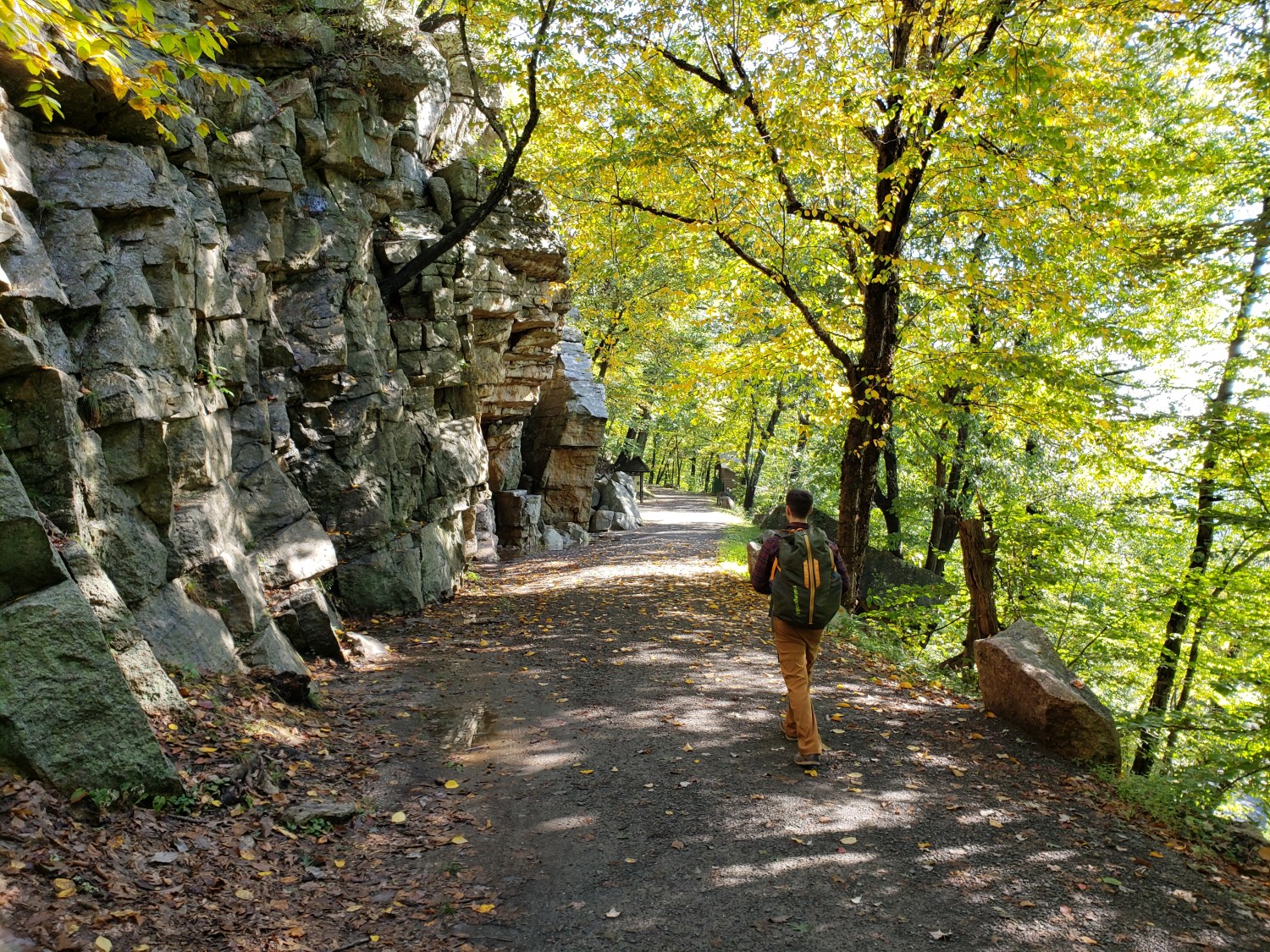
I’ve been trying to make more local trips to the Gunks lately as the weather has really improved in the NE. Especially because I knew I would be starting full time employment again, I tried to make the most of my time and just get outdoors (#optoutside) as much as possible before it became a more limited luxury again. The first such trip was for bouldering, where I put some work into a few new projects, and the second was my first trad lead, first rapel, and first multipitch experience (woo!).

After sending Andrew’s Problem (v4) and my bouldering success at Rumney, I felt like it was time to push myself a little harder and try some of the classic v5s at the Gunks. I went with MJ (and my trusty pup Scooter) on a pretty empty weekday, and we decided to try The Fin (v5) first which both of us had previously attempted a few months ago. The problem revolves around using heelhooks and compression to traverse along the side of a large fin-looking structure (hence the name). The holds are pretty slopey but there are sharp incuts on the surface to dig your skin into when slapping along the edge. I made decent progress, but was not able to suss out how to top it out/finish the problem, as the fin juts out over some exposed rock; a bad fall or swing out could send you tumbling over the cliff a little, or at least that’s what I was worried about. Interestingly enough, my biggest takeaway from this climb came from how my body felt afterwards: I had never felt my hips ache so badly from heel hooking before. Generally, I consider myself pretty flexible, especially in the hips, and feel that I have a good understanding of how to engage my hips/heel when using heel hooks. However, some of the best heel locations on the rock for The Fin are located at a height slighty above your hands, which themselves are located at your head height. I was just barely managing to eke out some compression from my heels, and had constant trouble with them slipping out of my shoe/off the rock. After thinking about my hip aches and how I had been using my heel on this problem, I realized I had barely been engaging my heel while projecting and had merely relied on the rubber on my shoe to keep me on. If I had been better about doing the heel hooks properly, my knees would have been bent and I would have been able to drive more force down from my hip flexors into my heel…something to think about for next time.

Next, we walked along the carriage road to Black Boulder (v5), something I had passed many times but had never jumped on. The problem is rather short and low to the ground, and for me it really comes down to a 2/3 move sequence leading into the top out. Here, my hip flexibility really came handy as it let me skip an intermediate slap with my right hand and allowed me to just go for the “good” sloper right from the start. But I got here relatively quickly, and was never able to finish the left hand move to the lip successfully. Dyanamic movements have always been hard for me, and there was no cheating this one. I made a lot of different attempts, but decided to come back when it was a little colder (and maybe a little stronger) to hopefully stick the move.

Towards the end of the day, we moved to Meaning of Life (v5) which turned out to be a boulder that was completely suited to my style. The only downside was that it was located in a pit of large, jagged rocks, so the landing was always something to worry about. But compared to the other two sloper climbs, the slightly overhung crimps are the most natural type of style for me, as I have spent a lot of time on moonboard- type problems. My first go was actually pretty close, but each subsequent go became harder as my energy waned towards the end of the day. Overall, I’m looking forward to coming back to finish off these three quality boulders.

A few weeks after this, I got the chance to try trad climbing for the first time with Matt Ritter. We scheduled a last minute trip to the Gunks after seeing a small break in a week of rain, and were lucky enough to find some dry climbs. Matt took me up a two pitch 5.6 climb called Wrist, and later in the day I led my first trad pitch called Baby (5.6). I had always wanted to try trad, and am confident that it’s something I see myself getting invested in when I’m older, but never had a chance to go with someone experienced. After doing these pitches with Matt, I honestly don’t think I’ve learned so much non-climbing related knowledge in one day, as we covered anchors, switching leads, rapelling, and placing trad gear. I definitely don’t feel confident enough to lead anything remotely close to hard yet on gear, but the experience of placing the gear was really unique. One of the things I love about climbing is how creative and free you are to express your body and movement on the rock; whatever beta you choose to use is your own choice, and probably suited to your own personal preference/style. Whereas some people like dynamic movement, others might prefer a more controlled static style. Adding the gear placement into the mix was like extending that freedom to protection as well. All of a sudden, I was making choices that affected my own saftey, and I was relying on persoinal knowledge and judgement when placing cams and nuts. On the easier 5.fun sections, I could choose to run it out for 20 feet if I really felt confident and bold, and in fact Matt did so on some sections of Wrist. Now I only have to start the long and expensive process of putting together my first rack…

In a few more weeks, I’ll be heading back to Las Vegas to climb in Red Rock again, 6 months after my first sport climbing trip outdoors. I’m hoping to hop on some of the boulders I failed to send, and maybe try some harder sport climbs. Hoping the weather holds up!

  • Gym Training

Researching Hangboarding – Pt 1

zhengman's avatar zhengman October 2, 2018

So far in my climbing progression, I’ve avoided structured training as I’ve always been a firm believer that the best type of training for any given activity revolves around doing that activity consistently over time. I’m not arguing that hangboarding and campus boarding don’t get you strong, but I knew that for someone with such little climbing experience as myself (barely 2 years), I had a lot more technique and movement that I could practice on the wall before I needed to delve into specific strength training. I definitely still feel this way and feel that there’s a lot more progress and general climbing experience I can gain through just climbing, but started researching hangboarding recently to see what professionals/experts have to say about finger training. This Dave MacLeod video was touted as the only video one needs to watch on hangboarding, so I started with that.

Some takeaways from the Dave MacLeod hangboarding training:
Most important takeaway – LISTEN TO YOUR BODY
Much more important to listen to how your body is feeling on a specific day, and to adjust accordingly.
Maintaining a regular schedule and consistency are key over the long term, not worth getting inured while training

  • Warmup: Do some pullups (5 – 10), and some hangs on easy wrung
  • Do hangboarding training with maximum hang/strength output/effort involved
    • Recommends doing hangs where you can only hang for 7-10 seconds
  • 3 main grip types
    • 4 finger open hang
      • Index and pinky are hanging but middle and ring are bent
    • Half crimp
    • Full open hand (3 finger drag)
      • Pinky dropped, other fingers are fully open at middle joint
    • Additional exercises:
      • 2 finger pockets
      • Pullups/front levers, etc.
  • Structure workout around the 3 main grip types
  • Recommends 3 – 5 sets of maximum strength 1 rep hang
    • Don’t do a maximal strength exercise if you can’t deliver close to your max; rest up for the next session
  • Choose right intensity for your hang
    • Be creative when adjusting
      • Can add weight for two hand hangs
      • If trying to transition to one hand hang, add some counter weight for other hand to grab and take some weight off
  • For rest, take as long as it takes to reproduce the same effort
    • 45 – 90 sec recommendation
  • Structuring when to do max hang workout:
    • Often they only take around 30 min, so Dave fits them after a medium boulder/sport session
  • Form/Avoiding injury
    • Don’t swing or jump when getting into hang position
    • Make sure to chalk – never let a finger pop/slip as it shocks the rest of the fingers

Overall, I liked Dave’s general message and more loose, flexible approach to hangboarding. His attitude about listening to your body and being flexible but consistent in your workouts is a “big idea” that I strongly believe in. It’s also interesting that Dave prefers max hangs to other types of hangboarding such as repeaters. Next up, I’ll be doing some research on the other types of hangboarding (which are listed below in a reddit link).

Let's Discuss Hangboarding
byu/straightCrimpin inclimbharder

  • Gym Training

Dynamic Movement Practice

zhengman's avatar zhengman September 26, 2018

I have always naturally felt more comfortable with static climbing as opposed to more dynamic, “big” movement. Part of it comes from my desire to maintain control over my body’s movement, as well as some fear of injury if I were to flail wildly and land poorly. In the beginning, I actually held a (naive) view that dynamic climbers were somehow “less skilled” because they appeared to just rely on brute power to accomplish climbs, as opposed to utilizing techniques like flagging, heel hooking, etc. It’s definitely taken me some time to come around to the idea because I’ve avoided it for so long, dynamic movement is a serious weakness for me, and something I must work on if I want to climb harder/more varied styles of climbs.

So when I recently made a trip home to North Carolina, I tried to actively find climbs that would help me work this weakness. It definitely helps that the local gym there (Triangle Rock Club) happens to set much larger moves than my home gym in NYC, which is probably why I always thought their grading was a little sandbagged. The video above shows my efforts working through a boulder problem around my typical project level, and figuring out how to land the dynamic crux move.

The problem starts off by forcing a toe or heel hook to set up both hands, and after a few more setup moves, you’re forced to launch for a pinch off of one foothold that’s placed quite close to your hands. With your body forced into a small box, it was difficult to generate power from such a compressed position. I knew that the key to sticking the move was to concentrate on my right foot, but I wasn’t sure exactly what I needed to do other than press harder. Trying the move in isolation, I was able to stick it but always cut feet and wasn’t 100% that I would be able to replicate it successfully from the start. I finally managed to keep feet one time when I pushed with my right foot in the direction of my movement instead of directly up (timestamp 0:54). After a few more tries, I sent the problem a little messily as I still cut feet.

I feel the movement I learned while figuring out this problem can be applied to many different boulder problems from v5 and up. I originally thought that I just lacked commitment to the big movement, but after failing multiple times it turned out that I needed some small adjustments in beta/mental shift. Although I still cut feet on the send go, the adjustments I made leading up to that definitely helped me reach the pinch in a better/higher position to grab it solidly and hold to swing my feet back onto the wall.

  • Gym Training
  • Trip Reports

Post-Rumney and Fall/Winter goals

zhengman's avatar zhengman September 21, 2018

Fall temperatures are finally coming, so I wanted to organize my goals and gym training plans/ideas as well as recap a recent Rumney trip

Read More "Post-Rumney and Fall/Winter goals"

Blog at WordPress.com.
  • Subscribe Subscribed
    • Richard Zheng
    • Join 28 other subscribers
    • Already have a WordPress.com account? Log in now.
    • Richard Zheng
    • Subscribe Subscribed
    • Sign up
    • Log in
    • Report this content
    • View site in Reader
    • Manage subscriptions
    • Collapse this bar
 

Loading Comments...